Tex-Shadow: Synthesizing Textured 3D Shadow Art
via 3D-Aware Diffusion Prior

1CAUChung-Ang University, Republic of Korea

Derived from his Master's thesis at CAU; now with Smilegate  ·  *Corresponding Author

SIGGRAPH 2026 Los Angeles

Posters Program

2–3 View Inputs
Textured 3D Output
Dual-Mode Anamorphic + Shadow

July 19–23, 2026  ·  ACM SIGGRAPH 2026 Posters  ·  Los Angeles, CA, USA

NEWS

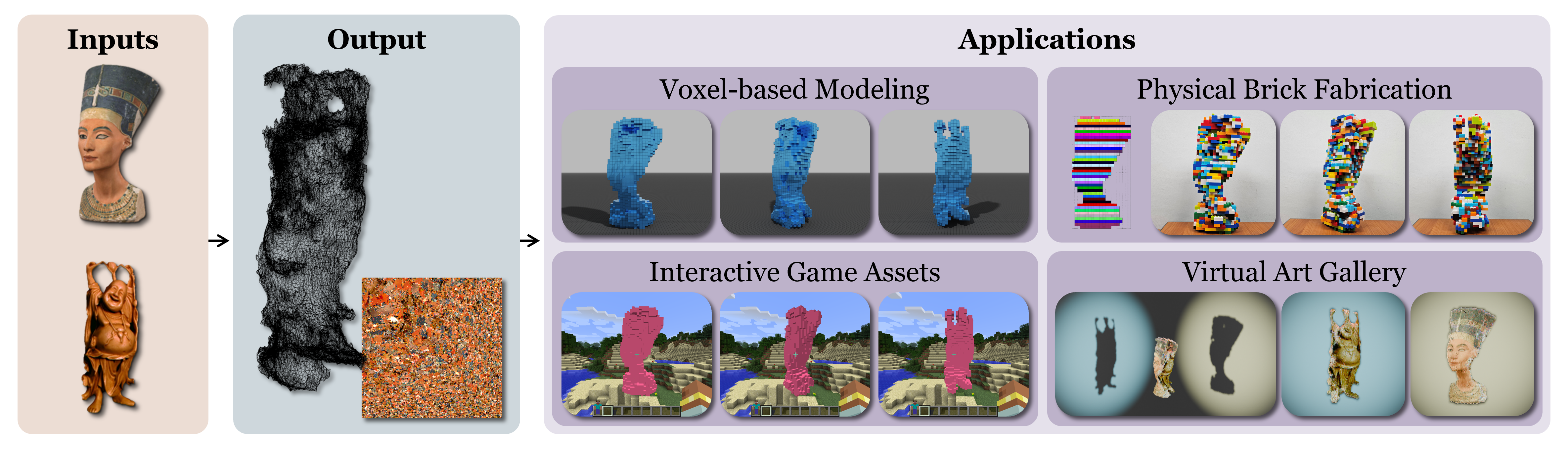
Teaser

Tex-Shadow: sparse inputs → textured 3D output → applications (Voxel, Brick, Game, Gallery)

Tex-Shadow integrates few-shot 3D reconstruction with inverse texture optimization to generate high-quality textured 3D objects for front-facing colorful anamorphic illusion and light-projected shadow art exhibitions. Generated assets are validated through physical brick fabrication and real-time game engine integration.

"Where Shadows Become Sculptures"

tl;dr  An optimization-based framework that leverages 3D-aware diffusion priors to automate the generation of high-quality textured 3D shadow art from sparse multi-view inputs — the first method to support both colorful anamorphic exhibitions and light-projected shadow art.

3D-Aware Diffusion Prior

Customizes a pre-trained 3D diffusion model via LoRA to handle semantic-free, sparse-view inputs.

Inverse Texture Optimization

Recovers fine-grained color through UV-space differentiable rendering for high-quality textured meshes.

Dual Exhibition Modes

First to support both colorful anamorphic illusions and light-projected shadow art from a single model.

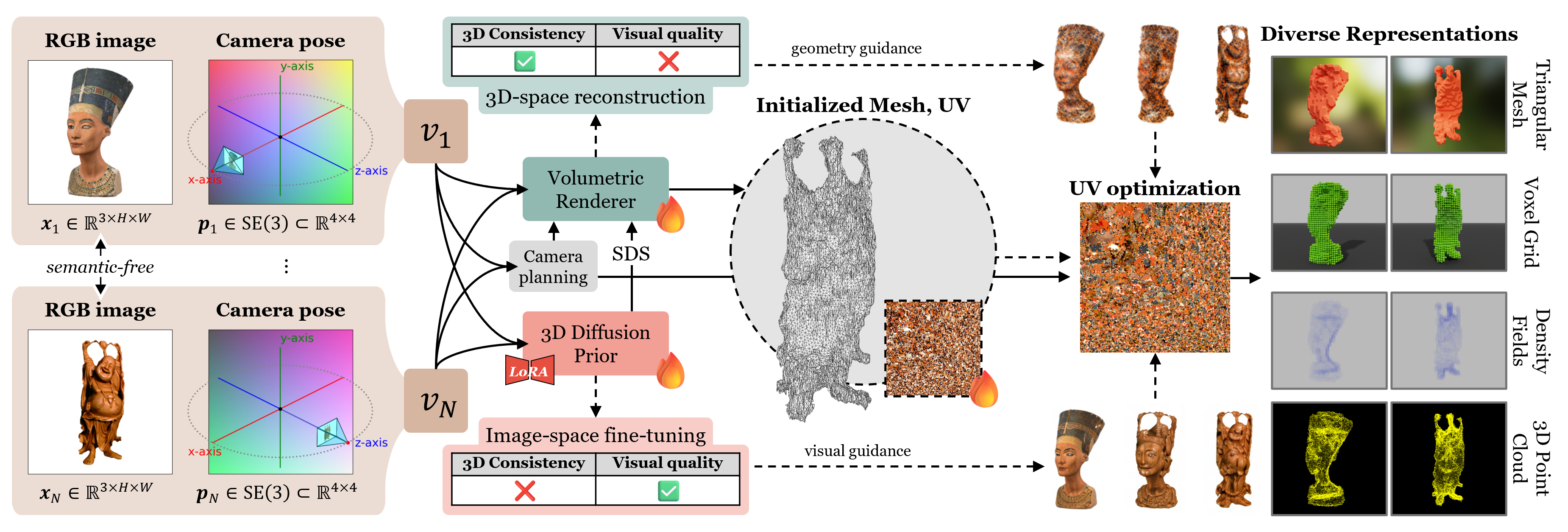
Method Overview

Tex-Shadow is a hybrid optimization framework that generates textured 3D meshes from N-view images with two main stages:

  • Customization for Semantic-free Inputs — A pre-trained 3D diffusion model is fine-tuned via LoRA on input image–pose pairs, enabling it to handle heterogeneous (semantic-free) inputs where each view depicts a categorically different subject.
  • Explicit 3D Reconstruction — The customized prior guides Instant-NGP via a hybrid Multi-SDS+ loss for 3D-consistent geometry. A subsequent UV-space inverse texture optimization step, run through a differentiable rendering pipeline, recovers fine-grained color details.

The resulting mesh is exported to diverse representations: triangular mesh, voxel grid, density fields, and 3D point cloud, enabling broad downstream use.

Tex-Shadow pipeline overview

Impact of 3D-Aware Diffusion Priors

Comparison: Video prior / Dense point + few-shot 3DGS / Feed-forward sparse 3D / Ours

Our customization scheme produces consistent topology and seamless visuals from semantic-free inputs. Compared to video priors (overall low quality), dense point initialization (highly unstructured, floating faces), and feed-forward sparse 3D models (exacerbated structure, low fidelity), our method achieves view-consistent and visually coherent reconstructions.

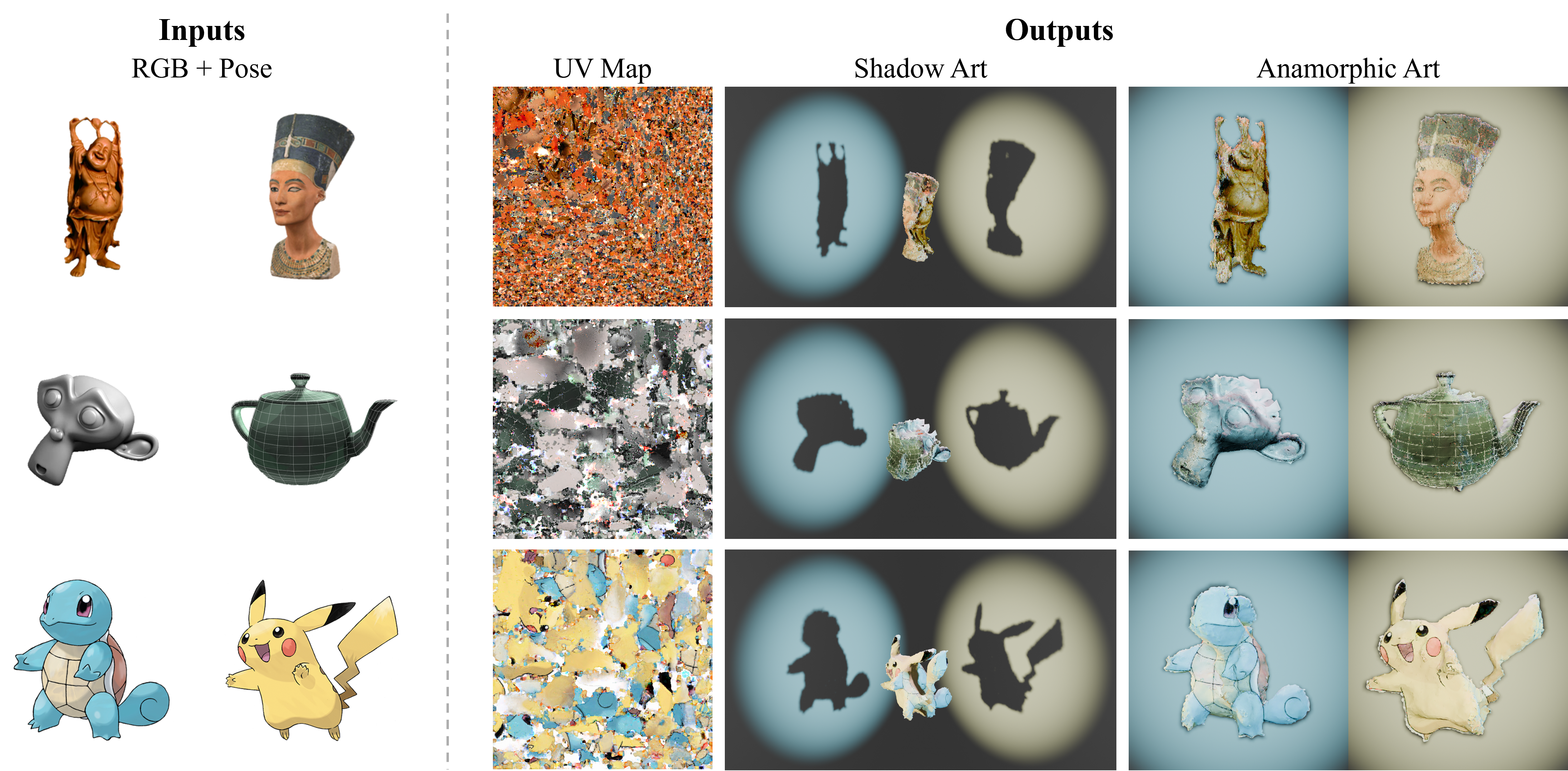
Results

Tex-Shadow results: colorful anamorphic art and light-based shadow art from 2/3-view inputs

Tex-Shadow synthesizes 3D sculptures that simultaneously satisfy colorful anamorphic appearances from the front and precise shadow silhouettes when projected from the rear. Results shown for both 2-view and 3-view inputs across anamorphic and shadow art modes.

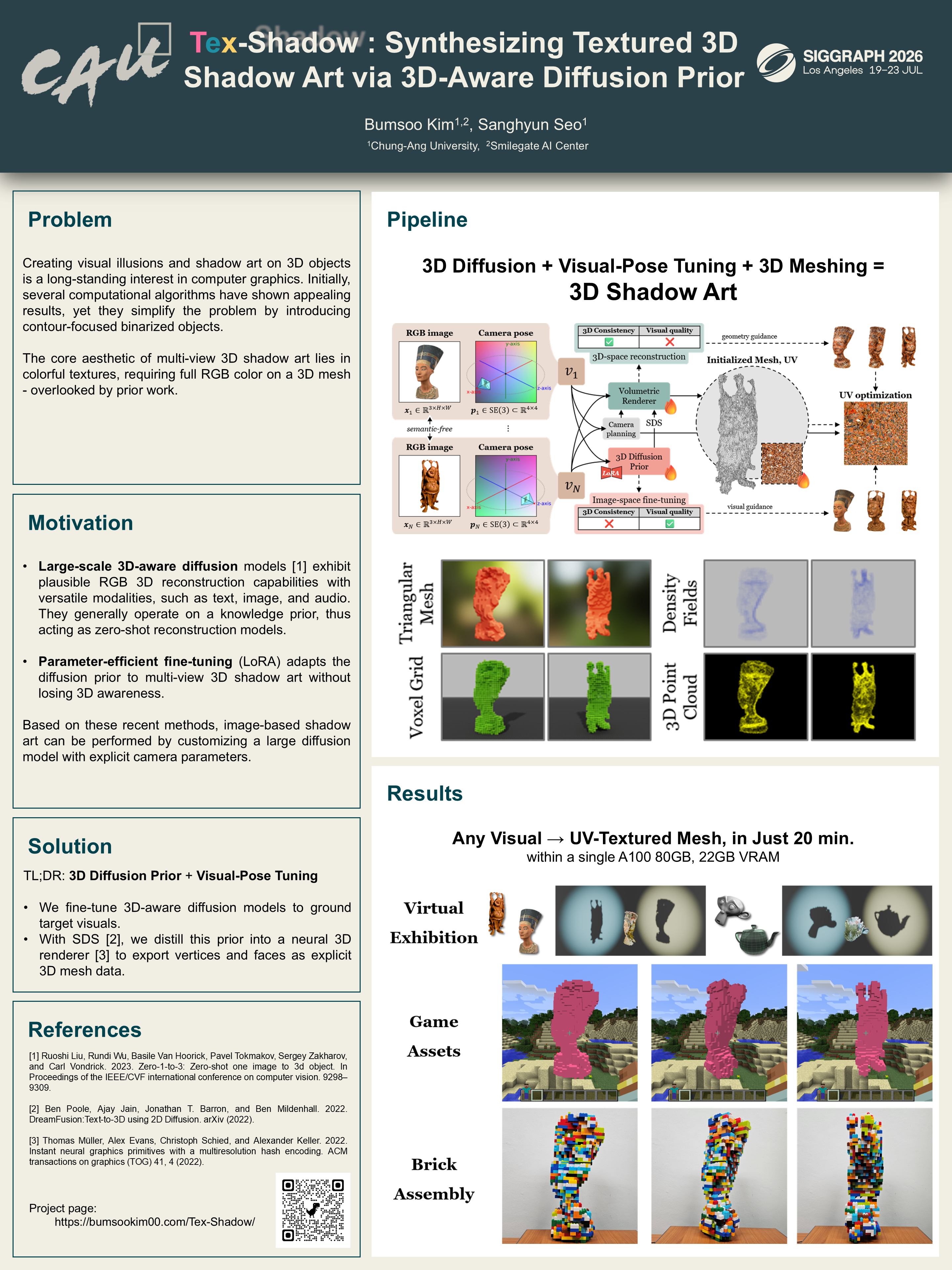
Poster

SIGGRAPH 2026 Poster

Interactive 3D Model Viewer

Interactive 3D assets will be available upon paper release.

Colorful Anamorphic Art

Example 01 — 2-View Input

Front: colorful texture  |  Rear: projected shadow

Example 02 — 2-View Input

Front: colorful texture  |  Rear: projected shadow

Example 03 — 3-View Input

Front: colorful texture  |  Rear: projected shadow

Light-Projected Shadow Art

Shadow Art — 2-View Input

Silhouette-preserving 3D sculpture

Shadow Art — 3-View Input

Silhouette-preserving 3D sculpture

Voxelized Output

Downstream: physical brick fabrication

BibTeX

@inproceedings{10.1145/3799825.3818723,
  author = {Kim, Bumsoo and Seo, Sanghyun},
  title = {Tex-Shadow: Synthesizing Textured 3D Shadow Art via 3D-Aware Diffusion Prior},
  year = {2026},
  isbn = {9798400725487},
  publisher = {Association for Computing Machinery},
  address = {New York, NY, USA},
  url = {https://doi.org/10.1145/3799825.3818723},
  doi = {10.1145/3799825.3818723},
  booktitle = {Proceedings of the Special Interest Group on Computer Graphics and Interactive Techniques Conference Posters},
  articleno = {13},
  numpages = {3},
  location = {
  },
  series = {SIGGRAPH Posters '26}
}

References

  1. (LRM) Hong et al., LRM: Large Reconstruction Model for Single Image to 3D. ICLR
  2. (LoRA) Hu et al., LoRA: Low-Rank Adaptation of Large Language Models. ICLR 2022
  3. (Differentiable Rendering) Laine et al., Modular Primitives for High-Performance Differentiable Rendering. ACM TOG 2020
  4. (Zero-1-to-3) Liu et al., Zero-1-to-3: Zero-shot One Image to 3D Object. ICCV 2023
  5. (Shadow Art) Mitra & Pauly, Shadow Art. ACM TOG 2009
  6. (Instant-NGP) Müller et al., Instant Neural Graphics Primitives with a Multiresolution Hash Encoding. ACM TOG 2022
  7. (DreamFusion / SDS) Poole et al., DreamFusion: Text-to-3D using 2D Diffusion. arXiv 2022dreamfusion3d.github.io
  8. (Multi-SDS / Wire Art) Qu et al., Wired Perspectives: Multi-view Wire Art Embraces Generative AI. CVPR 2024
  9. (Shadow Art Revisited) Sadekar et al., Shadow Art Revisited: A Differentiable Rendering Based Approach. WACV 2022
  10. (Zero123++) Shi et al., Zero123++: A Single Image to Consistent Multi-view Diffusion Base Model. arXiv 2023
  11. (MVDream) Shi et al., MVDream: Multi-view Diffusion for 3D Generation. ICLR 2024mv-dream.github.io
  12. (DreamGaussian) Tang et al., DreamGaussian: Generative Gaussian Splatting for Efficient 3D Content Creation. arXiv 2023dreamgaussian.github.io
  13. (HIFA) Zhu et al., HIFA: High-fidelity Text-to-3D Generation with Advanced Diffusion Guidance. ICLR 2024
  14. (FSGS) Zhu et al., FSGS: Real-time Few-shot View Synthesis using Gaussian Splatting. ECCV 2024